Home » Services » Orthopedics » Robotic Knee Surgery

Robotic Knee Surgery

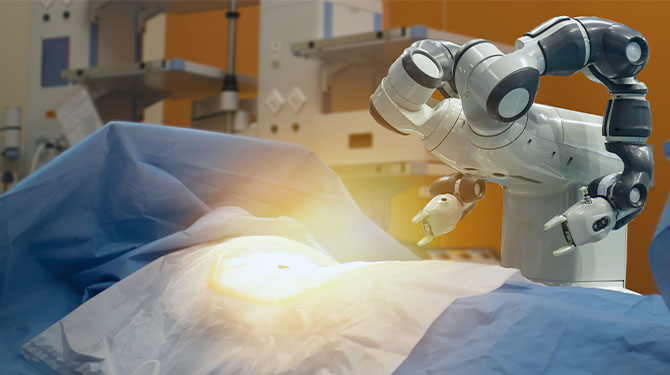
MAKOplasty® partial knee resurfacing is an innovative treatment option for adults living with arthritic knees, who are in early to mid-stage osteoarthritis (OA). It is powered by MAKO’s RIO™ robotic arm system which allows for consistently reproducible precision in performing partial knee resurfacing.

During the MAKOplasty® procedure, the diseased portion of the knee is resurfaced, sparing the patient’s healthy bone and surrounding tissue. An implant is then secured in the joint to allow the knee to move smoothly again.

Watch the video below for an overview of MAKOplasty® partial knee resurfacing.

Candidates for MAKOplasty®

Although the best treatment for each patient must be determined individually, typical MAKOplasty® patients share the following characteristics:

  • Knee pain with activity, usually on the inner knee and/or under the kneecap
  • Start up knee pain or stiffness when activities are initiated from a sitting position
  • Failure to respond to non-surgical treatments or non-steroidal anti-inflammatory medication

RIO Robotic Arm Interactive Orthopedic System

The MAKO Experience

Patient Benefits

MAKOplasty® partial knee resurfacing can:

  • Enable the preservation of healthy tissue and bone
  • Result in a more natural feeling knee following surgery
  • Result in a more rapid recovery and shorter hospital stay when compared to traditional knee replacement surgery
  • Be performed on an outpatient basis
  • Promote a rapid relief from pain and return to daily activities

Inpatient vs. Outpatient Procedure

MAKOplasty® can be performed as either an inpatient procedure or on an outpatient basis depending on what your surgeon determines is the right course of treatment for you. Hospital stays can average anywhere from one to three days. If the procedure is performed on an outpatient basis, patients return home the same day.

In many cases, patients are permitted to walk soon after surgery, drive a car within two weeks and return to normal daily activities shortly thereafter.

How does MAKOplasty® Work?

Before surgery, a CT scan is taken of the patient's knee, and a 3D model created using the RIO system's software. From this model, a pre-surgical plan is developed for the positioning of implants based on that patient's unique anatomy.

To ensure implants are optimally positioned and that the soft tissues of the knee are balanced for a good surgical outcome, surgeons can test and fine tune the plan before surgery by moving the leg through different ranges of motion. The RIO provides measurements and visualization, and the surgeon adjusts the plan as needed.

Once the surgical plan is finalized, it is programmed into the RIO, which creates a safety zone for bone removal. While the surgeon guides the robotic arm and is in control of it at all times, the RIO ensures that bone removal stays with the safety zone of the surgical plan, providing auditory, visual and tactile feedback, stopping the robotic arm if necessary before bone can be removed outside the planned area. Once the bone preparation is complete, the implants are placed in the knee.

Payment

Like other knee arthroplasty procedures, MAKOplasty® is covered by most Medicare-approved and private health insurance providers.

Please speak with your physician to determine your healthcare benefits, and if MAKOplasty® may be the right treatment option for you. 

Lifespan of a MAKOplasty® Implant

Knee ImplantThe life expectancy of all implants depends on several factors including the patient’s weight, activity level, quality of bone stock and compliance with their physician’s orders. Proper implant alignment and precise positioning during surgery are also very important factors that can improve the life expectancy of an implant.

Through the use of MAKO's RIO™ robotic arm system, implants can be optimally aligned and positioned to ensure the longest benefit. RESTORIS® MCK implants enable the treatment of one or two compartments with OA disease. With single compartment disease, a second compartment may be treated in the future if OA spreads.

In addition, because very little bone is actually removed during a MAKOplasty® procedure, the implants can be replaced with another procedure such as a total knee replacement, if necessary. 

Questions to Ask Your Surgeon

  1. Is osteoarthritis a factor in my knee pain?
  2. Will reducing activity, taking pain or prescription medication, getting injections or adding physical therapy help ease my pain?
  3. Would a knee replacement or partial knee resurfacing procedure provide relief from my knee pain?
  4. Am I a candidate for the MAKOplasty® partial knee resurfacing procedure?
  5. What are the benefits and risks involved with knee replacement surgery or the MAKOplasty® procedure?
  6. How long will it take to recover from a total knee replacement surgery? From a MAKOplasty® procedure?
  7. How long can I expect the implant to last?
  8. How does my age affect the proper treatment for my condition?

Download Our Brochure

Download and print the MAKOplasty® brochure and bring it with you to your next doctor's appointment.

Find an Orthopedic Surgeon

If you are searching for an orthopedic doctor in the Buffalo, NY area, click here to search our physician directory or contact our HealthConnection representatives at (716) 706-2112 from 7:30 a.m. to 6 p.m., Monday - Friday.

More Information

Phone  Call our HealthConnection line at (716) 706-2112, 7:30 a.m. to 6 p.m., Monday - Friday
Email Email us

Get in Touch

Postal Mail
2121 Main Street, Suite 300
Buffalo, NY 14214

Employment
1-877-247-5989

HealthConnection
716-706-2112
Click here to email us

Join Our Talent Network

Our Affiliates